(Updated 12/01/2013)
Gathering food from the desert offers an attractive alternative to the challenges of desert gardening. The harvest season for many desert foods is during the spring and especially the summer months. The list of edible plants is long. Here are a few of our favorites along with suggestions for harvesting, preserving and preparing:
Mesquite pods (Prosopis sp.)
Mesquite pods were a traditional staple among indigenous peoples of the southwestern deserts. The 6-8" pods, which ripen on this ubiquitous desert tree from June through September are high in both protein and carbohydrates. Trees often produce prolifically.
Ripe pods virtually
fall off the branch or at most require only a slight pull. Hard
pulling indicates that pods are unripe. Avoid pods that appear
to have fungal growth on the outside. Because of this, pods are
best gathered before monsoon rains begin in July and are best
gathered directly from the tree rather than off the ground.
Pods are easily cleaned by dunking them in a pail of water,
swishing them around and then drying them in the sun for several
days or until they are brittle. The test for dryness is this: if
you try to bend a pod, it should snap in two rather than
bending.
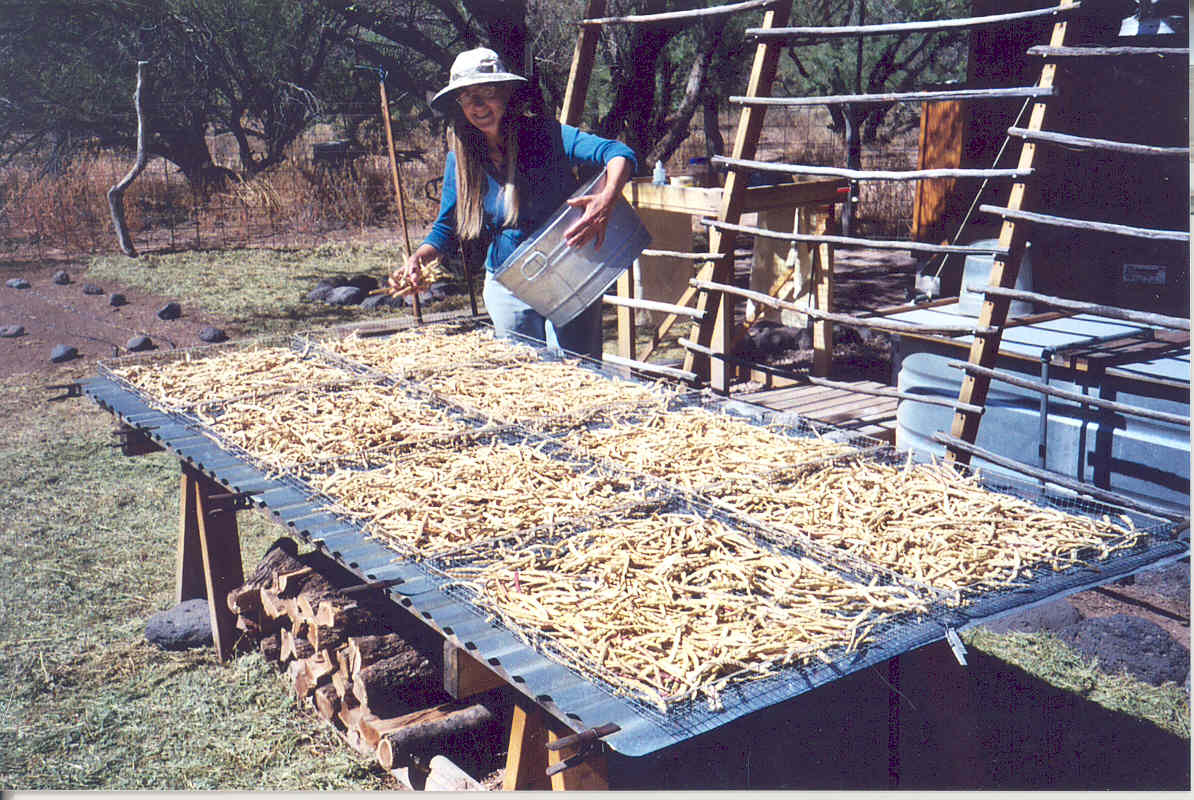
Drying mesquite pods
Milling is the bottleneck of processing mesquite pods. Meal was traditionally made in a labor intensive process using stone or stone and wood implements. Modern mills make the work much easier, but the only types that will work are those that pulverize the pods. The reason is that the pods are sufficiently high in sugar that they will quickly gum up grinding type mills. Although home blenders can be used, it is harder duty than they are designed for and will shorten their life. Much better is a hammermill, which uses rapidly rotating tines or "hammers" to pulverize the pods into flour. Even with a hammermill, it is important that the pods be brittle dry or they won't mill well. Pods tend to absorb atmospheric moisture, so drying is usually necessary just prior to milling. Again, the test for dryness is this: if you try to bend a pod, it should snap in two rather than bending.
If a significant time lag occurs between gathering and milling, pods may become infested by small brucchid beetles that tunnel into the pod to lay eggs. We usually wash and dry the pods again a few days before milling, which eliminates most of the bugs.
Cascabel Mesquite
Milling Day
In 1998, a small group of people in the Tucson/Cascabel area purchased a used hammermill from a local rancher, then reconditioned it. The mill is powered by a motor vehicle. We make it available for one day in the fall of each year for free public milling of mesquite pods for home (non-commercial) use. If you would like to be on the email list to be notified of the date, see "Email us" on the Home Page.

Hammermill set up for milling mesquite pods

Emptying tray of milled pods

The Martian who runs the mill
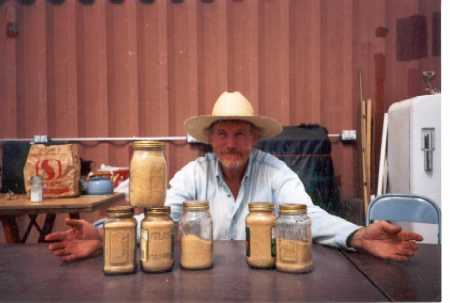
The finished mesquite meal--ready for pancakes!
Now in its 15th year, the Cascabel Mesquite Milling has blossomed into a larger and more festive event and features a mesquite pancake and waffle breakfast, live music, crafts, native/local foods potluck and of course milling. We've also acquired an electric mill which does a very fine grind. Joining us with their portable mill is Desert Harvesters, a Tucson-based native foods advocacy group. Interest in mesquite milling is growing and a number of groups have begun millings throughout the southwestern U. S. in recent years.
For more information on gathering and using mesquite pods, see the Desert Harvesters website. For information on this year's Cascabel Mesquite Milling, see the Cascabel Conservation Association website.

Gail and Joe prepare mesquite pancakes to start the day.

Then Lynn and Miller provide music

Meanwhile, Jim has the earth oven heating up for potluck veggies.

Mesquite pods are sorted before the milling.

Ken and his assistant run the Cascabel hammermill

While Jeau and Charlie...

...run the Desert Harvester's mill

Rose and Yvon show folks how to make mesquite tortillas

Jim has the veggies ready by about noon

And the local foods potluck begins.
Pearl's locally famous mesquite pancake recipe:
Measure the following
dry ingredients into a glass jar or other tight
container in which the dry mix can be stored. Shake to mix. (I
usually
double or triple this recipe and mix and store it in a gallon
jar.)
1 cup mesquite meal
1 cup whole wheat flour
1 cup unbleached flour
1 tablespoon baking powder
1 and 1/2 teaspoons baking soda
1 and 1/2 teaspoons salt
When ready to make pancakes...
Whisk together in
mixing bowl:
1 egg
1 tablespoon oil
1 cup buttermilk, sour milk, or fresh milk with a tablespoon of
vinegar added
Add a cup of the dry
mix to the liquids and whisk all together. Add more
milk as needed to thin batter. (I usually end up using a total
of about a
cup and a quarter of milk.)
Cook on hot griddle and enjoy with your favorite syrup or toppings.
Saguaro Cactus Fruit (Carnegiea gigantea) ("sahuaro" in Spanish)

Above: Using net to catch saguaro fruit
Right: Processing saguaro fruit

Saguaro fruit, which grows on top of this tall cactus, ripens in late June and early July.
This one of the more strenuous desert harvests due to the heat of the saguaro fruit gathering season and to the height at which the fruit grows. Two people make a good team for gathering saguaro fruit. One uses a long pole topped with a short cross piece or hook to knock ripe fruit off the top of the cactus. The other person, using a large net, attempts to catch the falling fruit before it hits the ground and becomes contaminated with sand and pebbles.
A pole for harvesting can be made from dry saguaro ribs, lashed together with wire to make a pole long enough to reach the top of the cactus. A frame for a net can be fashioned using saguaro ribs with insect screen or cloth laced to the frame to form the net. Also carry along a knife, a spoon and a pail with lid. If the husk of the fruit is open, the strawberry-like fruit can be scooped out with a spoon. Otherwise, the husk is sliced open with a knife and then scooped out. Fruit which has dried in an already-opened husk is usually still good to eat, but not the fruit in unopened, blackened husks. Put all fruit in a clean, covered pail and be meticulous about keeping foreign particles out of it while walking from cactus to cactus.
The saguaro fruit is boiled briefly in a pot to kill any insects or eggs and can then be used to make jam following the recipe for peach jam. Fruit leather can also be made by spreading boiled fruit on heavy plastic sheeting or liners from cereal boxes and then drying in the sun. Cover fruit leather with a piece of screen to keep insects off while drying.
Prickly Pear Cactus (Opuntia sp.) (Nopal in Spanish)

Breaking off young prickly pear pad

Slicing off spines and glochids
This, like the mesquite, is a ubiquitous desert plant. Both pads and fruit are edible. Pads, known in Spanish as pencas, are usually gathered in spring when they are young and tender. The fruits, known in Spanish as tunas, ripen in August and September.
Whether gathering pads
or fruit, long metal tongs and gloves are helpful to prevent
being stuck by spines or by the short glochids that appear at
the base of spines and on the fruit. First time gatherers will
soon learn to appreciate the effectiveness of these defenses.
Heavy rubber gloves with long gauntlets afford good hand
protection.
Pads are gathered by simply slicing or breaking off tender young
pads from the cactus. Using a sharp knife and thick rubber
gloves, the spines and glochids are sliced off one by one and
the pads are then diced up into small squares. The diced pads,
known in Spanish as nopalitos, can be cooked in pinto beans,
with scrambled eggs, or used in stews.
Fruits are gathered when they turn a dark wine color. In a good
stand of prickly pear cactus, this is one of the quickest and
easiest of the desert harvests. Long tongs come into their own
here and buckets of the glochid covered fruit can easily be
filled in a short time. Fruits should be darkest purple color
and appear plump and glossy. Fruit is best when it comes off
easily with tongs, leaving a tuft of juicy fruit on the pad.
The simplest way to process the fruits is simply to peel and eat them (carefully to avoid glochids).
Fruit can also be processed to separate juice from pulp and hard seeds. First, using heavy rubber gloves, rinse fruit in a pail of water to wash off dust. Put rinsed fruit into a pot, mashing with potato masher or squeezing fruit with gloved hands. Bring mashed fruit to a boil (don't add water), then pour cooked fruit into a clean pillow case and suspend above another container overnight to collect magenta-colored juice. Juice can then be frozen or canned (leave 1" of head room in jars) for later use in jelly, sorbet, etc. The grape recipe from Pomona's pectin works well for jelly. Syrup can be made using the same recipe but half the pectin.
Greens
A variety of desert greens can be used, including saltweed (atriplex wrightii), pigweed (amaranthaceae), common purslane (Portulaca oleracea), tumbleweed (Salsola iberica) and london rocket (Sisymbruim irio). Most species are best used in spring when young and tender and can be eaten in salads or as cooked greens. These can also be dried for later use.

Gathering the tender tips of saltweed
Recommended reading:
--Food Plants of the Sonoran Desert by Wendy C. Hodgson
--American Indian Food and Lore by Carolyn Niethammer