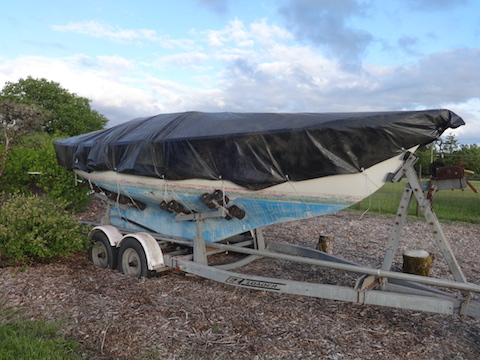
Minimus
tarped for the winter
(Posted 10/18/2016)
After we bought Minimus (not her name at the time) in September of 2015, we tarped her for the winter and headed south to Arizona. In early June of 2016, we were back in Oregon and began a summer's worth of work to make her ocean worthy.
| Minimus
tarped for the winter |
Before describing the specifics of the deck, cabin and hull work though, we should mention three aspects of the boat work that so far we're sold on.
Latex
Paint:
We used latex paint on the deck, hull and cabin interior, since the
advantages over oil paint are considerable. Drying time is greatly reduced, it smells better and is easier to work with. Cleanup is much easier and so are touch-ups. The deck was painted with semi-gloss acrylic latex paint, applied mostly with a foam roller. After a summer's worth of traffic while working on the boat, the deck paint still looks great.
We'll be reporting on its performance as our trip proceeds during 2017, but so far we're impressed.
 We used Valspar semi-gloss latex paint from Lowes for the deck and cabin. When the weather was hot and dry, we added Floetrol to help it flow better. |  We used Sherwin Williams Infinity semi-gloss paint for the hull and some of the exterior wood work. Here we're painting over teak, as we don't want to spend our sailing time keeping up with varnishing or oiling wood. |
Butyl
Tape:
Fortunately, we came across a website on bedding deck fittings with butyl tape before we started the outfitting. The two principles outlined on that website are simple. First is to chamfer every deck hole with a chamfer bit. This creates a space around the fastener which the caulk then fills to form a water-tight gasket. Chamfering also helps prevent future gelcoat cracking. The second principle is to use butyl tape instead of caulk from a caulk gun. Butyl tape stays flexible virtually forever, so never becomes brittle. It also provides a water-tight seal without adhering the fitting to the deck, so years down the road when another refit is due, removing the deck fittings isn't a major chore. Compared to other types of caulk, cleanup is a breeze and the cleaned up bits can be reused. We can't imagine ever going back to using another type of caulk.
 Chamfering holes in deck |  Holes after chamfering |
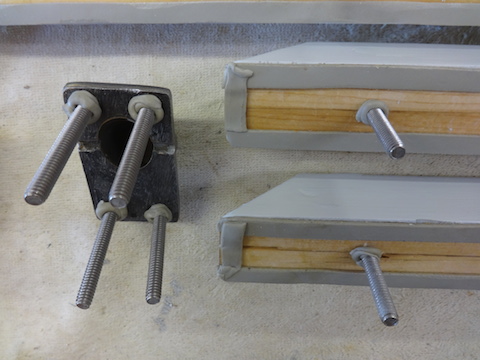 Fittings with butyl tape applied, ready to mount. | 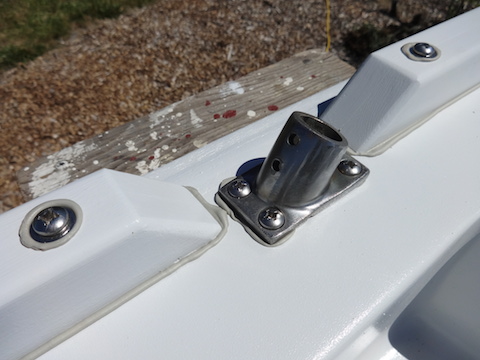 Butyl squeezes out from fittings after tightening. Removing excess is easy and not messy. The excess can be re-used. Great stuff. |
Deck
Work:
When we got her, Minimus had numerous deck leaks around various fittings. After the work described below, right after we finished the last of the deck work, we had unusually heavy rains that dumped over 9" of rain in a week. Not a drop came below and the bilge remained dry as a bone.
We did a major refit on the boat, starting with the deck. We removed virtually every fitting, including bow and stern pulpits, stanchions, port lights, toe rails, hatches, etc. Some gelcoat cracking in a few areas of the deck suggested possible core rot, though the tapping tests sounded solid. To be sure though, we drilled more than a dozen holes in various parts of the deck and cockpit. To our relief, every hole revealed fresh looking balsa core. There were only a couple very small areas of rot, one where the rudder post goes through the cockpit floor and the other at the deck fitting for filling the water tank. Each was only a few square inches in area and easy to dig out and replace with epoxy putty. Rather than doing cosmetic work on the gelcoat cracks, we re-glassed the deck from the rear of the cabin to the bow with a layer of 4 oz. glass cloth in epoxy resin.
We also covered the companionway hatch, the hatch sheath and the fore hatch with 1/2" MDO covered with 2 coats of epoxy. The hatches, which were initially flexible enough that we avoided standing on them, are now rock-solid. First, we removed all deck hardware and wood work, including the toe rail. |  All hatch covers also came off. |
 Then the endless sanding began, followed by adding a layer of fiberglass set in epoxy from cockpit to bow. | 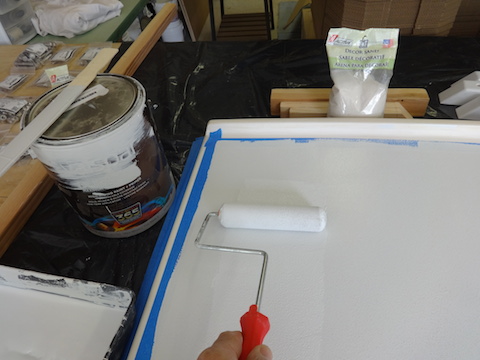 A non-skid surface was applied to most of the horizontal deck surfaces. First, a coat of paint was applied... |
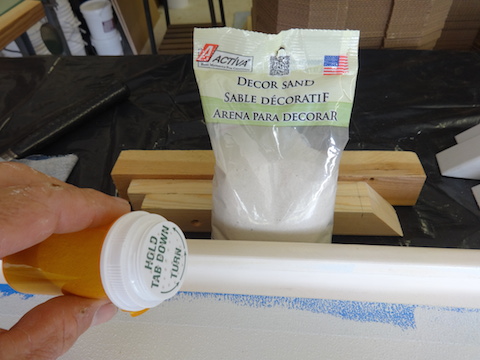 ...then sand was sprinkled onto the wet paint. (The pill bottle has 1/16" holes drilled in the cap and serves as the "sand shaker.") After drying, two more coats of paint were applied. | 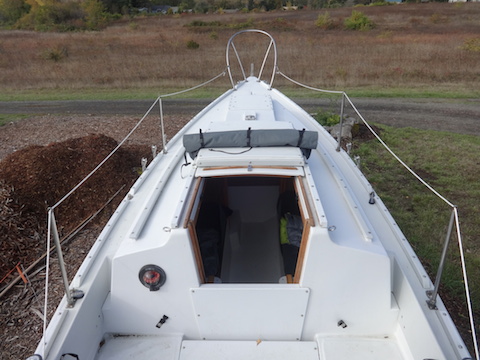 Deck after re-installing hardware and new toe rail. |
 Forward end of cockpit, with upper companionway washboard in place. The lower washboard is permanently attached and is higher than the cockpit coamings. The removable upper washboard is stronger and more water tight than ordinary washboards, to resist waves coming aboard from astern if we should ever have to lie to the series drogue in heavy weather. |  Aft end of cockpit footwell, showing large cockpit drain into lazarette. |
 For offshore sailing, a flaw in many small sailboats is a large cockpit with inadequate drains. A wave filling the cockpit in heavy weather can dangerously weigh the boat down. We designed this hinged 'gate' between the cockpit and the lazarette. It's normally held closed with shock cord, but a wave filling the cockpit will force it open. The purpose is to allow waves coming into the cockpit to drain quickly into the lazarette and out through the bottom. |  The grate in the bottom of the lazarette has six 2 inch diameter drain holes to quickly drain the cockpit. The small volume of water remaining in the footwell will drain through the original cockpit drains at the front of the footwell. |
 Finished cabin |  Forward
end of cabin, showing mast step reinforcement. Compressive mast loads now come down to white beam, then down to the hull. |
 We cut two circular hatches in the v-berth, opening up significant new storage space. | 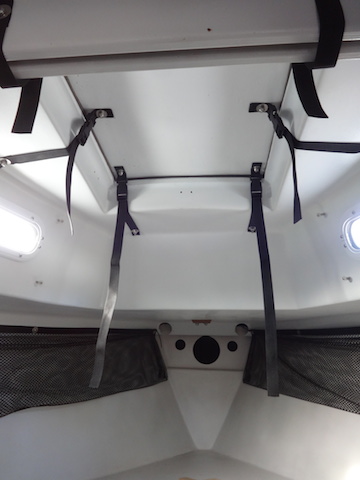 Underside of fore hatch, showing 6 straps for dogging it down tight. |
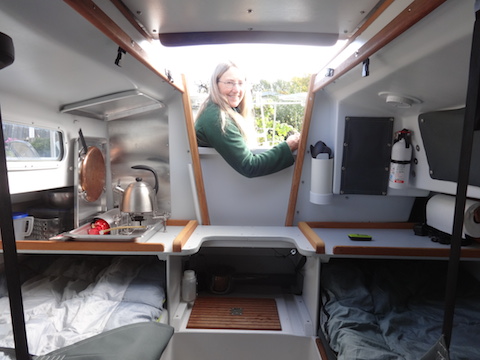 New counter at aft end of cabin. |